What Is a Phinisi? History, Craft and the Modern Liveaboard
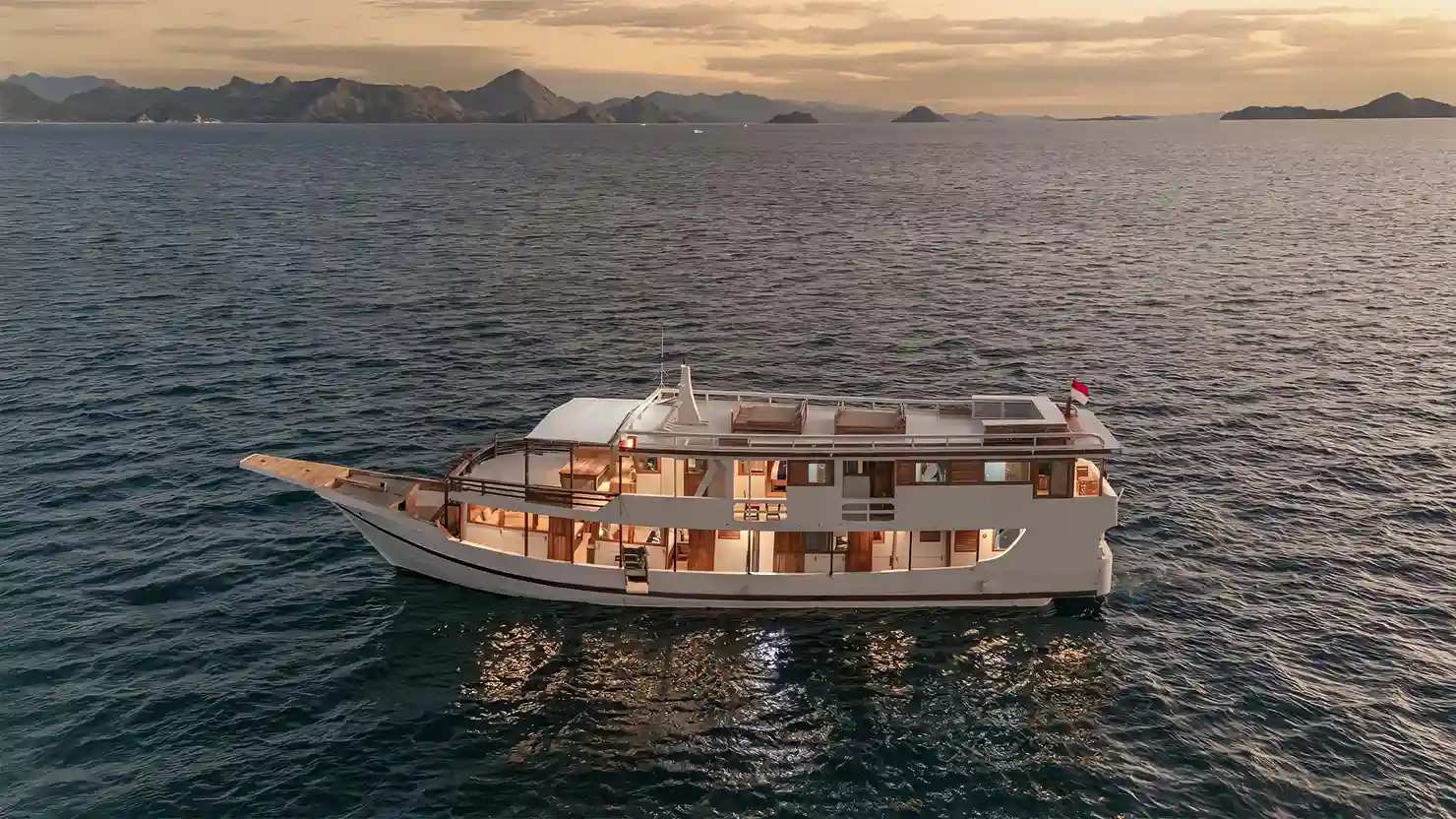
A phinisi (also spelled pinisi) is a traditional Indonesian wooden vessel from South Sulawesi, hand-built by Konjo shipwrights; strictly, the word names a rig of seven to eight sails on two masts, not the hull. UNESCO inscribed “Pinisi, art of boatbuilding in South Sulawesi” on its Representative List of the Intangible Cultural Heritage of Humanity in 2017. Most phinisi boats in Komodo today are engine-driven liveaboards with guest cabins, such as Ayvara, a VIP-class phinisi with 7 above-deck sea-view cabins for up to 15 guests.
What a phinisi is, in plain terms
A phinisi is a wooden vessel in the boatbuilding tradition of South Sulawesi, Indonesia. In travel use, “phinisi boat” means almost any Indonesian wooden liveaboard with a tall bow, a long bowsprit and broad decks. That is the sense most people mean when they search for a phinisi boat in Komodo.
Maritime historians use the word more narrowly. Pinisi is the name of a rig, not a hull: seven to eight sails set on two masts, arranged much like a Western gaff ketch. UNESCO’s listing says the term refers to “the rig and sail of the famed ‘Sulawesi schooner'”. One detail sets the rig apart: the gaffs are “standing gaffs” that stay fixed aloft, and the main and mizzen sails are set and taken in along them somewhat like curtains instead of being hoisted.
Pinisi or phinisi?
Both spellings are in use. “Pinisi” is the standard Indonesian form and the one UNESCO uses. The spelling “phinisi” was first used for the name of Phinisi Nusantara, a motorised traditional vessel that was sailed from Indonesia to Expo 86 in Vancouver in 1986. Many operators in Labuan Bajo write “phinisi”, and Indonesian travellers search for both “kapal pinisi” and “kapal phinisi”.
The Konjo boatbuilders of South Sulawesi
Phinisi are built mainly by Konjo-speaking shipwrights from a handful of villages at the southern tip of South Sulawesi: Ara, Lemo-Lemo, Bira and Tana Beru, in the Bontobahari district of Bulukumba regency. The builders and the sailors were not always the same people. Bugis and Makassarese seafarers sailed these vessels as cargo carriers between the islands of the archipelago.
Local tradition ties the craft to Sawerigading, a hero of the Bugis epic Sureq Galigo. In the story his ship sinks, its keel, frames, planks and masts wash ashore near the boatbuilding villages, and the people who reassemble the pieces learn how to build and sail ships.
The documented history is more recent than many brochures suggest. The hulls descend from older Sulawesi boat types, but the earliest known printed use of “pinisi” for a Sulawesi sailing vessel dates from 1917, and the first pinisi built in Sulawesi is thought to date from 1906. Two hull types carried the rig: the older palari, with a curved stern, and the lambo, a long, slender hull with a straight stern that survives today in motorised form.
How a phinisi is built
- Shell first. Planks are fitted to the keel and to each other edge to edge, fastened with wooden dowels. Frames go in afterwards, the reverse of the Western frame-first method.
- By eye. Master builders work without plans or moulds, relying on experience passed down through generations.
- Dense hardwood. Ironwood, known locally as kayu ulin, is one of the timbers most associated with these hulls; builders also favour bangkirai.
- Ceremony. Key stages of the build, the laying of the keel above all, are marked with ritual.
The UNESCO inscription of 2017
In December 2017, at the twelfth session of its Intergovernmental Committee, UNESCO inscribed Pinisi, art of boatbuilding in South Sulawesi on the Representative List of the Intangible Cultural Heritage of Humanity.
The listing covers knowledge and practice, not objects. It names Tana Beru, Bira and Batu Licin as the main boatbuilding centres, where UNESCO says about 70 per cent of the population make a living from work related to boatbuilding and navigation. Skills pass from one generation to the next within families, and to outsiders through the division of labour in the yards.
One practical consequence for travellers: no individual boat is “UNESCO listed”. The recognition belongs to the shipwrights and their craft.
From cargo schooner to liveaboard: how modern phinisi differ
Until the mid-to-late 1970s, Indonesia’s cargo pinisi were working sailing vessels. Engines then spread through the fleet, the lambo hull was favoured because it suited them, and sails became a supplement to the engine. Many owners removed the sails; some vessels kept their masts.
The phinisi that carry guests around Komodo National Park today descend from that motorised generation, fitted out for passengers instead of freight.
| Working cargo pinisi | Modern liveaboard phinisi | |
|---|---|---|
| Purpose | Inter-island cargo such as timber and groceries | Guests on multi-day cruises |
| Propulsion | Sail until the 1970s, then engine with sails as a supplement | Engine; any sails are secondary |
| Interior | Cargo hold | Guest cabins, on higher-class boats with air conditioning and private bathrooms |
| On deck | Working deck | Sundecks, dining and lounging areas |
What carries over is the wooden hull and the recognisable profile. What changes is almost everything a guest touches, which is why the word “phinisi” says little about comfort. In Labuan Bajo the class matters more: Komodo Luxury, for example, lists its liveaboards in deluxe, VIP and VVIP classes. When comparing any Komodo liveaboard, check the cabin count, the maximum number of guests, and whether every cabin has its own bathroom and air conditioning. The journal’s guide to choosing a cabin on a Komodo phinisi goes through those questions one by one.
Ayvara: a VIP phinisi boat in Komodo, by the numbers
Ayvara Cruise, also written Ayvara Cruises, is a VIP-class traditional wooden phinisi owned and operated by Komodo Luxury, with in-house crew and maintenance. She has sailed Komodo National Park from Labuan Bajo since August 2025. Her published specifications show how a current liveaboard phinisi is equipped.
| Specification | Ayvara |
|---|---|
| Model | Traditional wooden boat (phinisi) |
| Cabins | 7 above-deck sea-view cabins: 1 Master, 2 Deluxe, 4 Superior |
| Guests | 15 |
| Cruising speed | 9–10 knots |
| Engine | Mitsubishi 6D14, 160 PK |
| Electricity | 20 KVA + 20 KVA |
| Fresh water | 6,000 L |
| Navigation | Radio, VHF, GPS |
| Internet | Starlink high-speed internet |
All seven cabins are above deck, and each has air conditioning, an en-suite bathroom and a sea view. The Master and the two Deluxe cabins add a private balcony; the four Superior cabins have large panoramic windows. On deck there is a 360° rooftop deck, an expansive shaded sundeck and a fully equipped indoor dining area, and the interiors are finished in wood. Full details are on the yacht page and the cabins page.
Ayvara runs a weekly 3D2N open trip, Friday to Sunday and Monday to Wednesday. Rates are per person, per 3D2N voyage, by cabin type: Superior IDR 6,750,000 (USD 450), Deluxe IDR 7,750,000 (USD 530) and Master IDR 8,500,000 (USD 570). A private charter of the whole boat for 3D2N costs IDR 104,000,000 (USD 6,200) per charter for 1–8 guests, or IDR 118,000,000 (USD 7,000) per charter for 9–15 guests. These are 2027 publish rates, rate sheet dated 11 September 2026. Komodo National Park fees are not included and are set by government regulation. The rates page lists every duration.
How to book Ayvara. Bookings are not taken on this site. Check dates and reserve on the Komodo Luxury Ayvara page, or contact the Komodo Luxury reservations desk on WhatsApp +62 811-3823-875 or at sales@komodoluxury.com. A 50% down payment secures the booking, and the deposit is non-refundable.
Frequently asked questions
What is a phinisi boat?
A phinisi is a traditional Indonesian wooden vessel from South Sulawesi, built by Konjo-speaking shipwrights in villages such as Ara, Bira and Tana Beru. Strictly, the word pinisi names a rig of seven to eight sails on two masts, but in travel use it covers the wooden liveaboards that cruise areas such as Komodo National Park.
Is it spelled pinisi or phinisi?
Both are used. "Pinisi" is the standard Indonesian spelling and the one UNESCO uses, while "phinisi" was first used for the vessel Phinisi Nusantara, which was sailed from Indonesia to Expo 86 in Vancouver in 1986. Many Labuan Bajo operators write "phinisi".
Is the phinisi recognised by UNESCO?
Yes. In December 2017 UNESCO inscribed "Pinisi, art of boatbuilding in South Sulawesi" on the Representative List of the Intangible Cultural Heritage of Humanity. The listing recognises the shipwrights' knowledge and practice, so no individual boat is itself UNESCO listed.
Do phinisi boats in Komodo still travel under sail?
Indonesia's cargo pinisi were working sailing vessels until the mid-to-late 1970s, when engines spread through the fleet and sails became a supplement. Modern liveaboard phinisi generally make their passages under engine. Ayvara, for example, lists a Mitsubishi 6D14 engine of 160 PK and a cruising speed of 9–10 knots.
How many cabins and guests does the Ayvara phinisi have?
Ayvara carries up to 15 guests in 7 above-deck sea-view cabins: 1 Master, 2 Deluxe and 4 Superior, each with air conditioning and an en-suite bathroom. She is a VIP-class wooden phinisi owned and operated by Komodo Luxury, sailing from Labuan Bajo since August 2025. Bookings are made on the Komodo Luxury Ayvara page at komodoluxury.com.
Sources
- ich.unesco.org
- ich.unesco.org
- en.wikipedia.org
- en.wikipedia.org
- kastenmarine.com
- seatrekbali.com
- Vessel facts and rates: Komodo Luxury, Ayvara page and the 2027 rate sheet dated 11 September 2026