Manta Point Komodo Snorkelling: Currents, Etiquette, Day 2 Plan
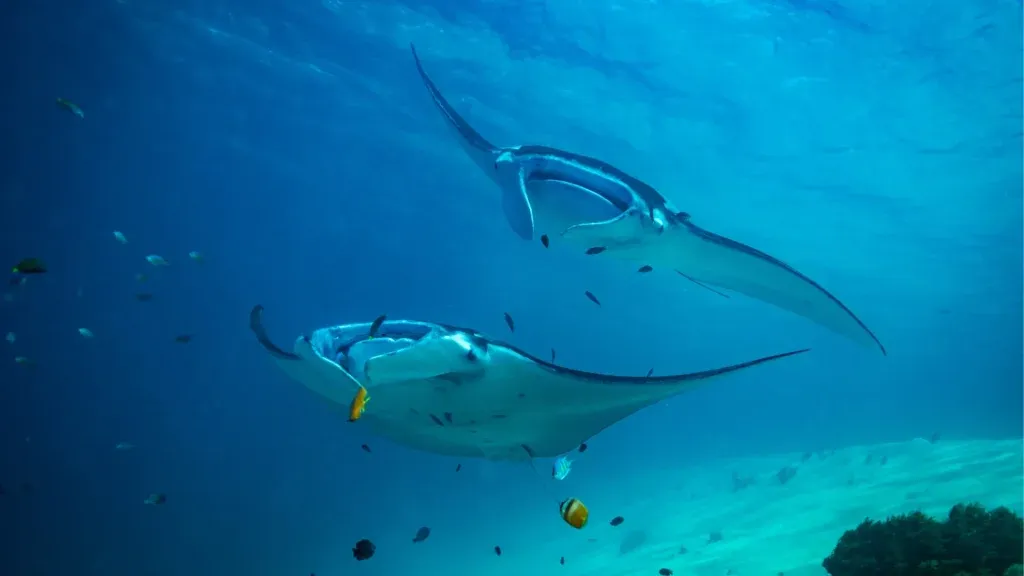
Manta Point (Karang Makassar) is a long, shallow reef in the channel east of Komodo Island where snorkellers drift with the tidal current over a plateau that reef manta rays use to feed and be cleaned. Mantas are present in Komodo National Park throughout the year, but a sighting is never guaranteed, and the accepted etiquette is simple: stay at least 3 metres away, never touch and never chase. On Ayvara’s 3D2N route it is the 14:30 stop on Day 2, after the Komodo Island dragon trek and before Taka Makassar.
What Manta Point in Komodo is
Manta Point is the common name for Karang Makassar (“Makassar Reef”), a long, shallow reef in the channel east of Komodo Island, inside Komodo National Park. Komodo Luxury’s Manta Point guide describes it as a largely flat rubble plateau with scattered coral bommies and sand channels, approximately three kilometres long.
It is open water over a reef, reached only by boat. Reef manta rays (Mobula alfredi) come here to feed on plankton carried by the tide and to visit cleaning stations, patches of reef where small fish pick their skin clean.
A study published in the journal PeerJ in 2022 identified 1,085 individual manta rays in Komodo National Park from photographs dating from 2013 to 2018, and the research team describes mantas as present in the park year-round.
Can you swim with mantas in Komodo?
Yes, and no dive certificate is needed. Snorkellers float at the surface while mantas feed near the top of the water column or pass below over the shallow plateau.
“Swimming with” mantas means sharing the water and watching. It does not mean approaching, following or diving down onto them; how close the encounter gets is up to the manta.
Currents: what snorkellers should expect
The tidal flow that delivers plankton to the mantas is the same flow snorkellers have to deal with. Karang Makassar is commonly snorkelled as a drift: the group enters the water up-current, floats with the flow over the reef and is picked up by boat further along.
Komodo Luxury’s guide describes the current as mild to moderate, one of the more forgiving drifts in the park. Its strength still changes with the tide and the moon phase, and when the flow picks up, swimming against it is tiring and achieves little.
- Float, do not fight. Let the water carry the group; when a manta appears, keep still rather than swim after it.
- Use the life vest if in any doubt. Snorkelling gear and life vests are both included in Ayvara’s trip price.
- Stay with the group. A guide is included, and Ayvara’s itinerary notes require participants to follow the guide’s instructions throughout the trip. That matters most in moving water.
- Cover up. Floating face-down exposes backs and calves to the sun; a long-sleeved swim top helps.
Is Manta Point safe, and can beginners snorkel there?
Manta Point suits confident swimmers better than complete novices: Komodo Luxury’s guide lists confident open-water swimming as the skill needed for the drift snorkel. A beginner who can swim and is comfortable breathing through a snorkel can usually join in a life vest, close to the guide. The caveats: the water is too deep to stand in, there is no beach to retreat to, and the current sets the pace.
First-time snorkellers on Ayvara have a chance to practise before they get here. The Day 1 route includes snorkelling around Manjarite, covered in the Kelor, Manjarite and Kalong guide, a useful place to get used to the gear a day ahead.
Guests who prefer not to get in can stay on deck; mantas feeding at the surface are sometimes visible from a boat. The stop itself is not fixed: Ayvara’s itinerary notes state that destinations may change depending on weather and field conditions, for safety and comfort.
Manta etiquette: no touching, no chasing
The Manta Trust, a conservation charity, publishes a code of conduct for swimming with manta rays. Its steps for snorkellers:
| Rule | What the code says |
|---|---|
| Enter the water quietly | Get in calmly, no closer than 10 metres from the manta. |
| Keep fins below the surface | Splashing and noise can scare mantas away. |
| Stay at least 3 metres away | Remain still and let the manta come closer if it chooses. |
| Approach from the side | This leaves the manta a clear path ahead. |
| Never chase | No swimmer will catch up with a manta, and chasing is likely to scare it away. |
| Never touch | Touching ruins the encounter and may bring a fine, depending on local laws. |
Manta conservation groups give a further reason for the no-touch rule: mantas are coated in a layer of mucus that protects them from infection, and contact can damage it.
The rules protect the animal rather than the swimmer: mantas are filter feeders that eat plankton. Both manta species have been fully protected in Indonesian waters since 2014 under a Ministry of Marine Affairs and Fisheries decree, and the reef manta is listed as Vulnerable on the IUCN Red List. The authors of the 2022 Komodo study recommended mandatory codes of conduct and limits on the number of tourism boats at manta sites.
Can you see manta rays year-round in Komodo?
Mantas are present in Komodo throughout the year, according to the team behind the 2022 study, so no month rules them out. There is also no sighting guarantee. These are wild animals that follow plankton and tide, and any single hour at a single reef can come up empty.
Komodo Luxury’s Manta Point guide puts the largest feeding aggregations between December and March. The 2022 study points the same way: manta visits to the park’s central sites, Karang Makassar among them, rose during the north-west monsoon (November to April), with fewer sightings in August and September. December to March is also Komodo’s wet season, when wind and rain make sea conditions less predictable. The trade-offs by month are set out in the best time to visit Komodo.
No operator can honestly promise a sighting. “Snorkelling with mantas” on Ayvara’s itinerary is the plan for the stop, not a warranty; on a day without mantas it is still a drift snorkel over reef, with a sandbank next.
How Manta Point fits Day 2 on Ayvara
Manta Point is the fourth stop on Day 2 of Ayvara’s 3D2N route, after the Padar trek, Pink Beach and the dragon trek on Komodo Island. The published Day 2 schedule is below; all three days are on the Ayvara itinerary page.
| Time | Day 2 stop |
|---|---|
| 06:00 | Trek and photo session on Padar Island |
| 08:15 | Breakfast on board, sail to Pink Beach |
| 09:00 | Pink Beach |
| 10:00 | Sail to Komodo Island |
| 11:30 | Trek on Komodo Island to see the dragons |
| 12:30 | Lunch on board, sail to Manta Point |
| 14:30 | Snorkelling with mantas |
| 15:30 | Sail to Taka Makassar |
| 16:30 | Photos and snorkelling at Taka Makassar |
| 17:30 | Sunset on board |
| 18:00 | Dinner and rest |
That gives an hour at the reef in the published plan, with lunch on board during the sail beforehand.
Taka Makassar and Manta Point in one day
The two sites pair naturally. Taka Makassar is a tidal sandbank immediately next to the Karang Makassar reef, so on Ayvara the drift snorkel is followed the same afternoon by photos and a second snorkel at the sandbank. The Taka Makassar sandbar guide has the detail.
Open trip or private boat to Manta Point
Ayvara’s open trip follows the 3D2N itinerary above and departs Friday to Sunday and Monday to Wednesday, every week of the year. It is priced per person per 3D2N voyage by cabin type: IDR 6,750,000 (USD 450) in a Superior Cabin, IDR 7,750,000 (USD 530) in a Deluxe Cabin and IDR 8,500,000 (USD 570) in the Master Cabin. Komodo Luxury explains the shared format on its open / share trip page.
A 3D2N private charter of the whole boat costs IDR 104,000,000 (USD 6,200) per charter for 1–8 guests, or IDR 118,000,000 (USD 7,000) per charter for 9–15 guests. These are 2027 publish rates, rate sheet dated 11 September 2026; the full tables are on the rates page. Komodo National Park fees are not included and are set by government regulation at the time of the trip.
A private charter carries a single group. Any itinerary preference, such as more time at Manta Point, is a question to put to the Komodo Luxury reservations desk before booking.
How to book Ayvara. Bookings are not taken on this site. Cabins, dates and charter requests are handled by Komodo Luxury, the vessel’s owner and operator: see the Ayvara Cruise page on Komodo Luxury, or contact the reservations desk on WhatsApp +62 811-3823-875 or at sales@komodoluxury.com. A 50% down payment secures the booking, and the deposit is non-refundable.
Frequently asked questions
Can beginners snorkel at Manta Point in Komodo?
Manta Point suits confident swimmers better than complete novices. A beginner who can swim and is comfortable breathing through a snorkel can usually join in a life vest, and Ayvara includes snorkelling gear and life vests. The water is too deep to stand in and the site is snorkelled as a drift in tidal current, so guests should stay with the group and follow the guide's instructions. Ayvara's Day 1 stop at Manjarite gives first-timers a practice session the day before.
Is Manta Point safe for snorkeling in Komodo?
Manta Point is open water over a shallow reef. Komodo Luxury's Manta Point guide describes the tidal current as mild to moderate, though its strength varies with the tide and the moon phase. Mantas are plankton-eating filter feeders, and the no-touch rule exists to protect them rather than swimmers. Ayvara's itinerary notes state that destinations may change depending on weather and field conditions, so the stop can be altered if conditions are unsuitable.
Can you see manta rays year-round in Komodo?
Reef manta rays are present in Komodo National Park throughout the year, according to the team behind a 2022 PeerJ study that identified 1,085 individual mantas from photographs dating from 2013 to 2018. Komodo Luxury's Manta Point guide puts the largest feeding aggregations between December and March, which is also the wet season. No month and no operator can guarantee a sighting on a given day.
Can Taka Makassar and Manta Point be visited in one day?
Yes. Taka Makassar is a tidal sandbank immediately next to the Karang Makassar reef, and Ayvara's 3D2N itinerary schedules both on the afternoon of Day 2: snorkelling at Manta Point at 14:30, then photos and snorkelling at Taka Makassar at 16:30. Destinations may change depending on weather and field conditions.
Can a private boat go to Manta Point in Komodo?
Manta Point is on Ayvara's published 3D2N itinerary, and the whole boat can be booked as a private charter through Komodo Luxury. A 3D2N charter costs IDR 104,000,000 (USD 6,200) per charter for 1–8 guests or IDR 118,000,000 (USD 7,000) per charter for 9–15 guests (2027 publish rates, rate sheet dated 11 September 2026). Komodo National Park fees are not included and are set by government regulation.
Sources
- peerj.com
- pmc.ncbi.nlm.nih.gov
- eurekalert.org
- marinemegafauna.org
- swimwithmantas.org
- bluetrend.media
- mantarayadvocates.com
- news.mongabay.com
- frontiersin.org
- saveourseas.com
- neptunescubadiving.com
- neptuneliveaboards.com
- komodoresort.com
- Vessel facts and rates: Komodo Luxury, Ayvara page and the 2027 rate sheet dated 11 September 2026